The Trillion-Dollar Software Development Revolution Nobody's Getting Right
AI is transforming software development into a multi-trillion-dollar market, with agents revolutionizing how 30 million developers worldwide plan, code, review, and deploy software. Yet something's deeply wrong.
According to PwC's May 2025 survey, 88% of senior executives plan to increase AI-related budgets in the next 12 months due to agentic AI, and 79% say AI agents are already being adopted in their companies. But here's what nobody's talking about: fewer than 45% are fundamentally rethinking their operating models.
They're polishing the Titanic's deck chairs while the entire ocean of software development transforms beneath them.
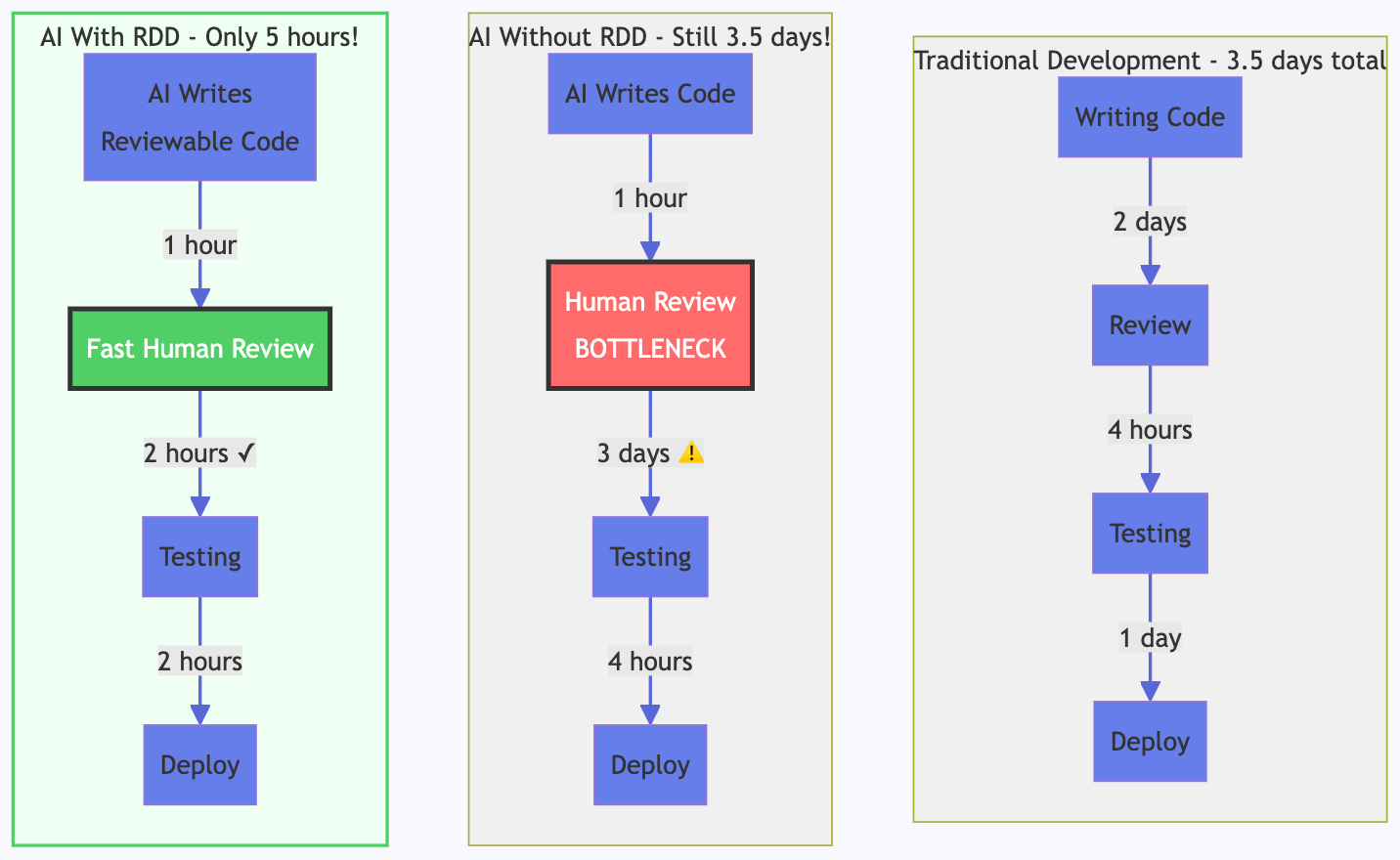
The Dirty Secret: AI Is Creating More Work, Not Less
Harvard Business Review dropped a bombshell that Silicon Valley doesn't want to discuss: 41% of workers have encountered AI-generated "workslop"-content that appears polished but lacks real substance, costing nearly two hours of rework per instance.
Think about that. Nearly half of all workers are spending two hours fixing AI's mistakes. That's not productivity. That's expensive theater.
The culprit? "Vibe coding"-the fast, loose, and entirely prompt-driven approach that's infected development teams worldwide. As Simon Willison warns, this approach ships demos, not systems. It's coding by feeling rather than engineering by design.
The Uncomfortable Truth About Building with AI Agents
Building AI agents is 5% AI and 100% software engineering. Let that sink in. While everyone's obsessing over which model to use, the teams actually shipping are focused on data pipelines, guardrails, monitoring, and ACL-aware retrieval.
According to IBM's developer survey, 99% of developers are exploring or developing AI agents, but most are doing it wrong. They're treating agents like magic boxes instead of what they really are: powerful tools that require even more discipline than traditional development.
The stakes are massive. Andreessen Horowitz estimates the AI software development stack is becoming a multi-trillion-dollar market, with agents transforming how 30 million developers worldwide plan, code, review, and deploy software. But the gap between promise and reality is widening.
The Four Models Everyone's Using (And Their Hidden Costs)
After analyzing hundreds of development teams and agency engagements, four distinct models have emerged for building in the agent era. Each promises speed and quality. Most deliver neither.
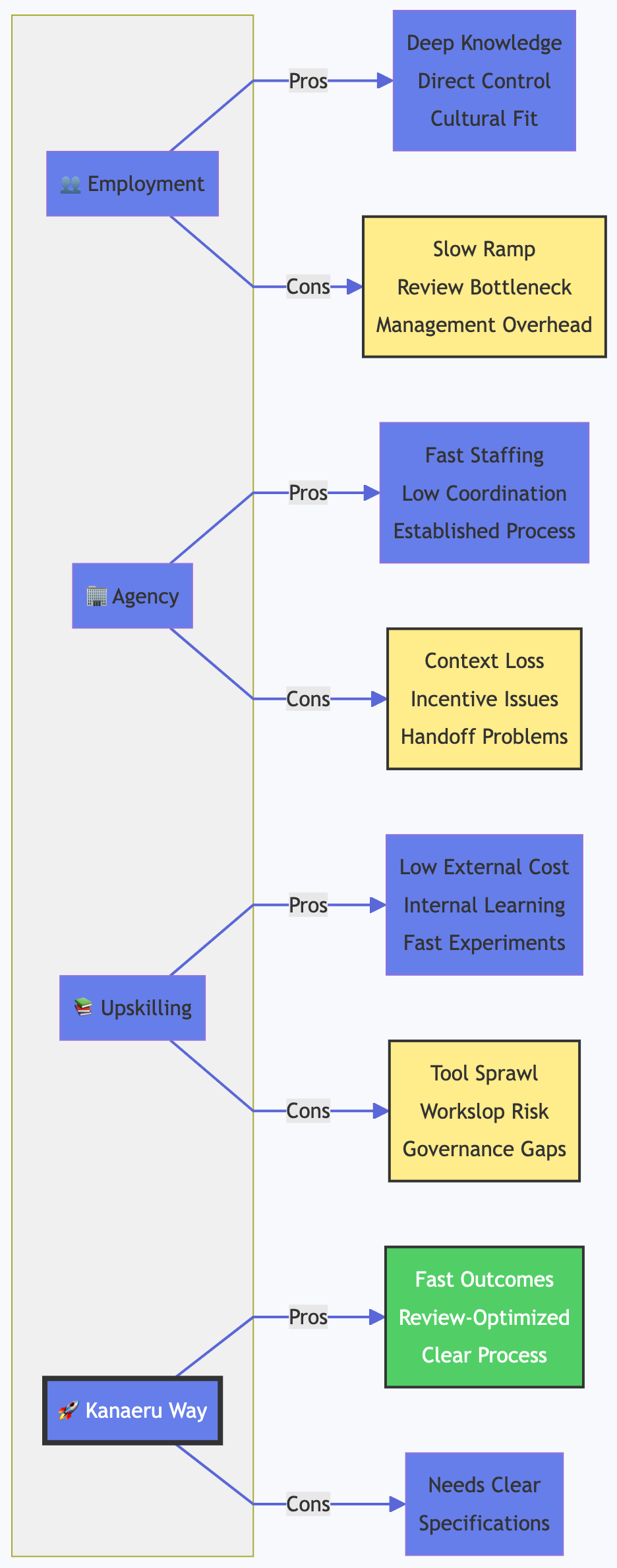
Model 1: Employment (Full-Time Teams or Freelancers)
The Promise: Direct control, deep domain knowledge, cultural alignment.
The Reality: You're hiring humans to manage AI badly.
Most internal teams haven't updated their processes for the agent era. They're using AI as a fancy autocomplete while maintaining the same review bottlenecks and handoff delays that plagued pre-AI development. Federated governance models and budget agility are critical for AI success, but few teams have implemented either.
The Hidden Costs:
- Hiring cycles that can't keep pace with AI evolution
- Senior engineers becoming review bottlenecks
- Uneven AI adoption creating quality gaps
- Management overhead that negates AI efficiency gains
When It Actually Works: Long-term products with stable scope and exceptional engineering leadership who understand AI-native development. If you don't have both, this model bleeds money.
Model 2: Outsourced Agency
The Promise: Elastic capacity, established processes, single accountability point.
The Reality: Yesterday's solutions for tomorrow's problems.
Traditional agencies are retrofitting AI into their existing workflows rather than reimagining delivery from first principles. They're using agents to generate more billable output rather than better outcomes. The result? Volume without value.
The Hidden Costs:
- Context loss at every handoff
- Incentive misalignment (more code ≠ better product)
- "Throw it over the wall" dynamics
- Post-project maintenance nightmares when their specific AI setup doesn't match yours
When It Actually Works: Well-bounded projects with crystal-clear specifications and minimal post-delivery evolution. Basically, when you don't actually need AI's adaptive capabilities.
Model 3: Upskilling In-House (Engineers + Business Users on AI Tools)
The Promise: Democratized development, rapid experimentation, compounding knowledge.
The Reality: Chaos dressed as innovation.
Workers at nearly 70% of Fortune 500 companies already use Microsoft 365 Copilot, but usage doesn't equal value. Without proper governance and methodology, you get tool sprawl, shadow IT, and the dreaded "workslop" that creates more work than it saves.
GitHub reports that the developer role is evolving weekly, and continuous learning on AI workflows is now table stakes. But learning without structure creates sophisticated mess-makers, not developers.
The Hidden Costs:
- Tool fragmentation (every team using different AI stacks)
- Governance gaps creating security and quality risks
- Rework from unverified AI output
- "Works on my machine" multiplied by every AI tool variation
When It Actually Works: Organizations with strong engineering culture and the discipline to standardize on proven methodologies before scaling AI adoption. Without that foundation, it's expensive experimentation.
Model 4: The Kanaeru Way (Outcome-Driven with RDD + SDD + AI-DLC)
The Difference: We don't sell AI. We deliver outcomes.
While others debate models and prompts, we've built a methodology that solves the real bottleneck:
- Review-Driven Design (RDD): Structure code for 10x faster human review
- Spec-Driven Development (SDD): Executable specifications that eliminate ambiguity
- AI-Driven Development Lifecycle (AI-DLC): Purpose-built for AI-human collaboration
The breakthrough insight: Agents can write code at superhuman speed, but humans still review at human speed. By optimizing code structure for reviewability-clear modules, obvious boundaries, self-documenting patterns-we eliminate the real bottleneck in AI development.
This isn't theoretical. AI agents are already transforming workforces across industries, but only when the code they generate is structured for human comprehension.
The Review Revolution: Why RDD Changes Everything
Here's the paradigm shift nobody's talking about: Writing code is no longer the bottleneck. Agents can generate thousands of lines in minutes. The new bottleneck? Human review time.
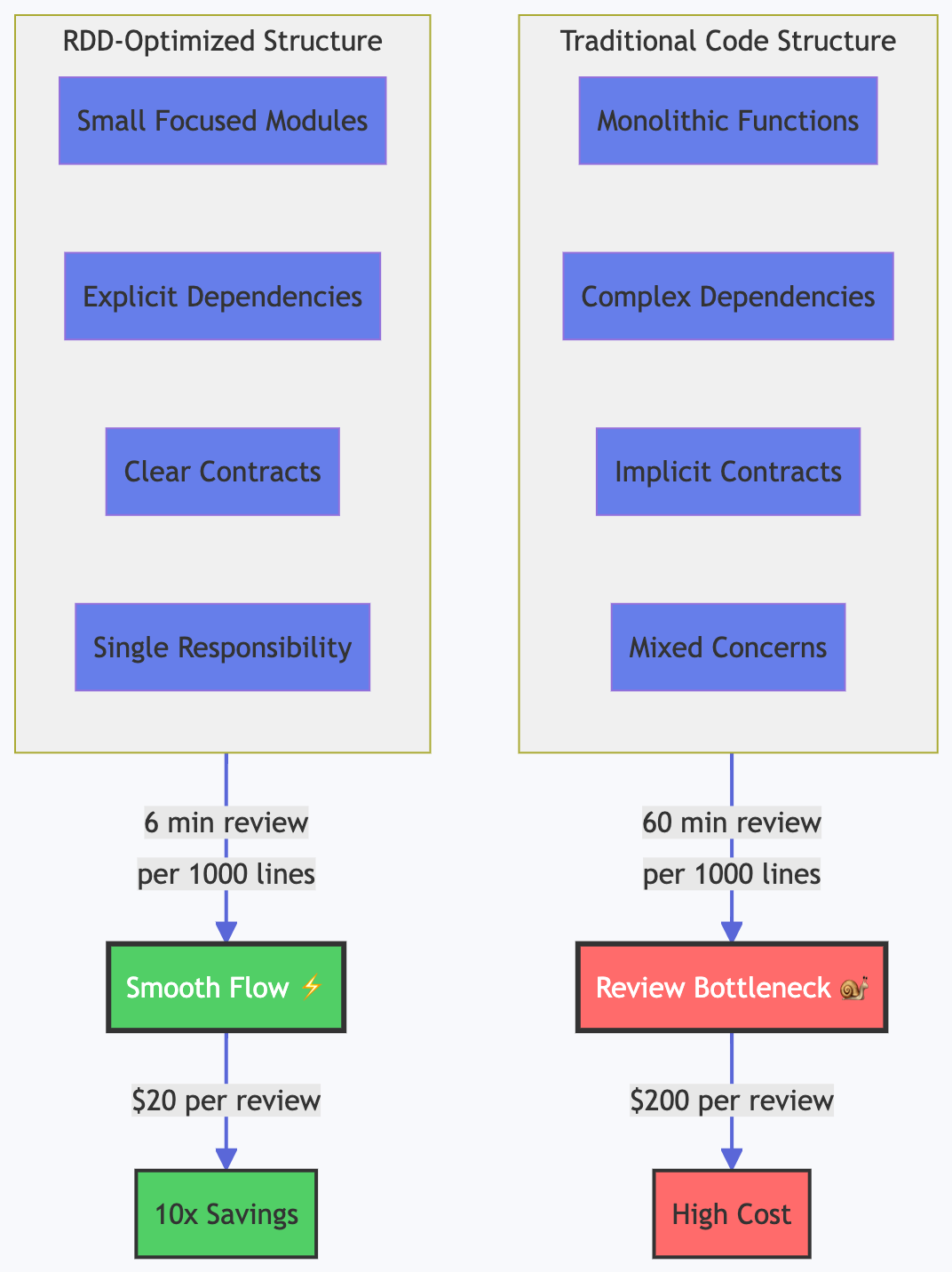
Review-Driven Design (RDD) solves this by structuring software specifically for human reviewability. Instead of optimizing for writing speed or execution efficiency alone, RDD optimizes for the scarcest resource in AI development: human attention.
The RDD Principles:
- Small, focused modules that fit in human working memory
- Clear separation of concerns so reviewers can verify one thing at a time
- Explicit dependencies that make impact analysis instant
- Self-documenting patterns that reduce cognitive load
- Testable boundaries that prove correctness locally
When agents generate code following RDD principles, a human can review 10x more code in the same time. That's not an incremental improvement-it's a fundamental unlock for AI-assisted development.
Modern tools are amplifying this approach:
- Greptile for AI pre-reviews that highlight what humans should focus on
- Vercel Agent for automated checks that reduce human review burden
- CodeRabbit (which just raised $60M) for intelligent review workflows
But tools alone don't solve the problem. The structure of the code itself must be optimized for review. That's what RDD delivers.
Why Spec-Driven Development Changes Everything
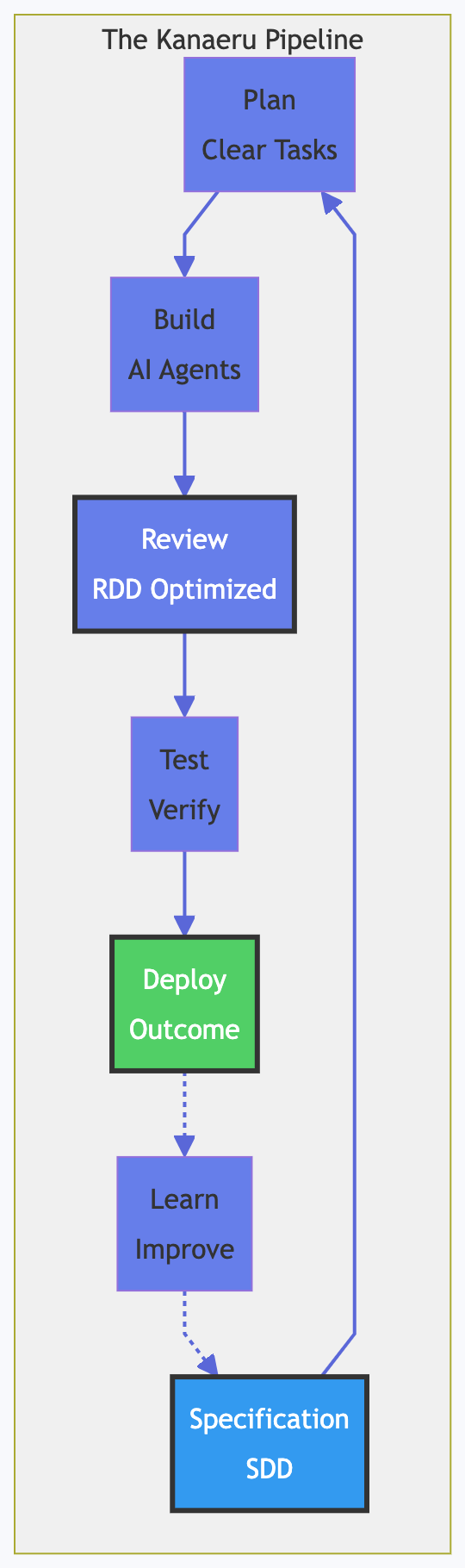
GitHub's Spec-Kit is revolutionizing how teams work with AI agents. Instead of prompt-and-pray, teams using SDD follow a disciplined flow: specify → clarify → plan → implement → verify. This spec-first approach works with Copilot, Claude Code, Gemini CLI, and other major AI coding assistants.
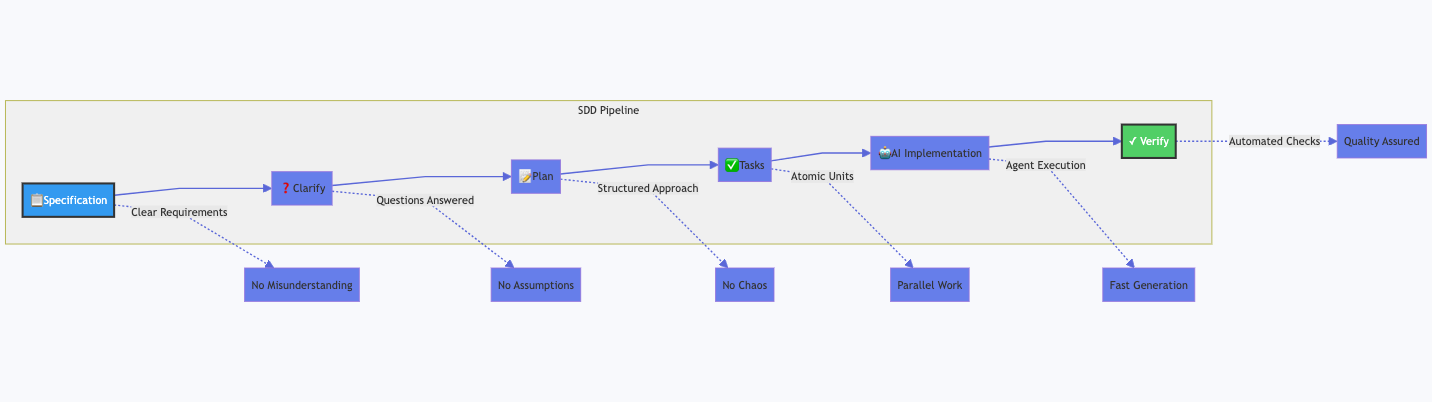
The results are dramatic:
- Ambiguity eliminated before coding starts
- AI agents working from clear specifications, not vague prompts
- Reviewable plans before implementation
- Verification built into every step
Tools like Kiro are taking this further, creating entire IDEs built around spec-driven agentic workflows. This isn't incremental improvement-it's a fundamental reimagining of how software gets built.
The AI-DLC Framework: Built for Agents, Not Retrofitted
AWS's AI-Driven Development Lifecycle represents a ground-up reimagining of software development for the AI era. Unlike traditional SDLC retrofitted with AI tools, AI-DLC integrates:
- Domain-Driven Design (DDD) for clear boundaries
- Behavior-Driven Development (BDD) for specification
- Test-Driven Development (TDD) for verification
- Continuous AI-human collaboration at every phase
The framework introduces new concepts like:
- Bolts: Iterations measured in hours/days, not weeks
- Units: Cohesive, self-contained work elements
- PRFAQ: Press Release FAQs that capture business intent
- Continuous upskilling: Agents that learn and improve
This isn't just theory. Japanese enterprises using AI-DLC report dramatic improvements in delivery speed and quality.
The Tool Ecosystem That Actually Matters
While everyone's arguing about GPT vs Claude vs Gemini, the real innovation is happening in the surrounding ecosystem:
Specification & Planning Tools
- GitHub Spec-Kit: Open-source SDD implementation
- Kiro: Agentic IDE for spec-driven development
- Claude-flow: Workflow automation for Claude Code
- CCPM (Claude Code Project Management): GitHub Issues integration for agent context
Agent Extensions & Tools
- MCP (Model Context Protocol): Enables agents to interact with external systems
- Chrome DevTools MCP: Gives agents browser debugging capabilities
- Browserbase MCP: Cloud browsers for agent testing
- Terragon: Background agents that work in parallel
Review & Quality Tools
- Greptile: AI reviews that understand context
- Vercel Agent: Automated PR reviews (now in public beta)
- CodeRabbit: Enterprise-grade AI review workflows
- Aviator Runbooks: AI-native dev environments
Observability & Learning
- OpenTelemetry for Claude Code: Agent performance monitoring
- Mem0: Persistent memory for agents
- Mix SDK: Multi-modal agent deployment
The teams winning with AI aren't using better models-they're using better toolchains.
The Market Reality: Who's Actually Winning
Consumer-facing industries are the fastest adopters of AI agents-retail, travel, hospitality, and financial services. According to ZDNet's analysis, response time directly impacts revenue in these sectors.
Key Statistics:
- 79% of companies say AI agents are already being adopted (PwC survey)
- 66% report measurable value through increased productivity
- But only 45% are fundamentally rethinking operating models
- And just 42% are redesigning processes around AI agents
The gap between adopters and adapters is massive. Adopters use AI tools. Adapters transform their entire delivery model. Guess who's winning?
The Speed of Change Will Melt Your Brain (Again)
Remember those AI benchmarks from 2023? Performance jumped by 18.8, 48.9, and 67.3 percentage points respectively in just one year. The inference cost for GPT-3.5 level performance dropped over 280-fold between November 2022 and October 2024.
But raw capability isn't translating to business value. Why? Because most organizations aren't agent-ready. They have the tools but lack the methodology.
When Each Model Actually Makes Sense
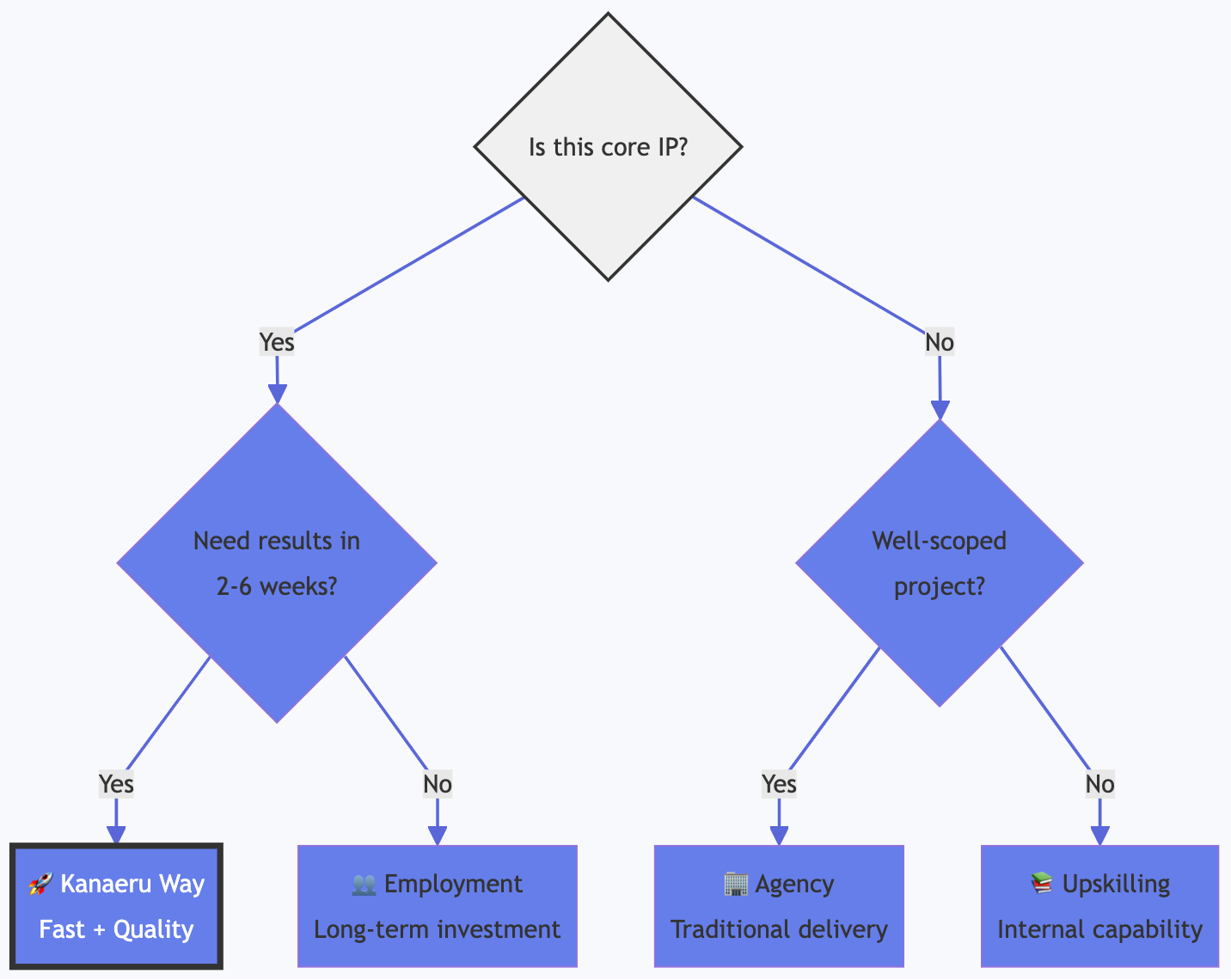
Choose Employment When:
- You're building core IP that defines your business
- You have multi-year roadmaps and patient capital
- Your engineering leadership understands AI-native development
- You can afford the 6-12 month learning curve
Choose Traditional Agency When:
- You have a well-scoped, bounded project
- The requirements are unlikely to evolve
- You don't need ongoing AI capability
- You're comfortable with traditional handoffs
Choose In-House Upskilling When:
- You have strong engineering culture and governance
- You're willing to invest in methodology before tools
- Your teams can handle temporary productivity dips
- You're building for the long-term
Choose The Kanaeru Approach When:
- You need results in weeks, not months
- Quality and maintainability matter as much as speed
- You want to leverage AI without the learning curve
- You're focused on outcomes, not output
The Three Principles That Separate Winners from Wannabes
1. Specification Before Generation
The teams shipping real value with AI start with specifications, not prompts. They use tools like Spec-Kit to create executable specifications that drive development. They clarify ambiguity before writing code. They plan before they build.
2. Review-Optimized Architecture
The breakthrough realization: Code generation is now instant, but review is still human-speed. Winning teams structure their entire architecture for reviewability. Small modules, clear boundaries, obvious dependencies. When a human can review 10x more code in the same time, velocity explodes. This is Review-Driven Design in action.
3. Lifecycle, Not Linear
AI development isn't a waterfall or even agile-it's continuous. The best teams use frameworks like AI-DLC that assume constant iteration, learning, and improvement. Every deployment teaches the system. Every bug becomes a rule. Every success becomes a pattern.
What "Outcome-Driven" Actually Means
When we say we deliver outcomes, not code, here's what that means in practice:
Traditional Approach: "Build us a user dashboard" Outcome Approach: "Reduce time-to-insight for users by 50%"
Traditional Approach: "Implement authentication" Outcome Approach: "Enable secure, frictionless user access"
Traditional Approach: "Migrate to microservices" Outcome Approach: "Achieve 99.9% uptime with independent scaling"
The difference isn't semantic. It's fundamental. When you focus on outcomes:
- Success metrics are clear from day one
- AI agents work toward business goals, not technical tasks
- Every decision traces back to value
- Rework drops because the target doesn't move
The Hidden Economics of AI Development
Here's what most cost analyses miss:
The Review Bottleneck Cost
Agents can generate 1,000 lines of code in 60 seconds. A human needs 60 minutes to properly review it. At $200/hour for senior engineers, that's $200 in review cost for every AI generation cycle. Without Review-Driven Design, this compounds exponentially. With RDD-where code is structured specifically for fast human review-the same 1,000 lines takes 6 minutes to review. That's a 10x cost reduction on your most expensive resource: senior engineering time.
The Rework Tax
AI-generated workslop costs nearly two hours of rework per instance. At developer rates, that's $200-400 per incident. Multiply by frequency and team size-the tax adds up fast.
The Context Cost
Every handoff, every new tool, every methodology switch has a context cost. Traditional agencies maximize handoffs (more billable hours). In-house teams minimize handoffs but maximize tool sprawl. Only integrated approaches minimize both.
The Opportunity Cost
While you're debating which AI tool to use, competitors are shipping. 75% of executives believe AI agents will reshape the workplace more than the internet did. The cost isn't just what you spend-it's what you don't ship.
Why Next Quarter Matters More Than Next Year
71% of executives believe AGI will arrive within two years. 50% say their operating model will be unrecognizable in two years because of AI agents.
Translation: The gap between leaders and laggards is widening exponentially. Companies moving slowly won't just fall behind-they'll become irrelevant.
But here's the paradox: Moving fast without methodology creates technical debt that compounds faster than AI improves. You need speed AND discipline. That's why methodology matters more than models.
The Kanaeru Difference: Outcomes Over Everything
We don't sell seats. We don't bill hours. We don't deliver code. We deliver outcomes.
Our approach combines:
- Specification-first development that eliminates ambiguity
- Review-driven quality that prevents rework
- Lifecycle thinking that improves with every iteration
- Tool-agnostic methodology that works with your stack
- Outcome-based contracts that align incentives
We've taken the best of what's emerging-GitHub's Spec-Kit, AWS's AI-DLC, enterprise review tools-and created a methodology that delivers.
The Questions You Should Be Asking
Instead of "Which AI model should we use?" ask:
- How do we specify work so agents and humans align?
- How do we review at specification time, not deployment time?
- How do we turn every project into organizational learning?
- How do we measure outcomes, not output?
- How do we move fast without creating technical debt?
The answers aren't in better prompts or bigger models. They're in better methodology.
What Happens Next
The software development landscape is bifurcating. On one side: teams using AI as a faster typewriter, generating more code with more bugs, creating more work. On the other: teams that understand AI requires new methodologies, not just new tools.
2025's agentic AI isn't about single-purpose bots, but sophisticated, task-oriented systems capable of holistic reasoning, collaboration, and learning.
The question isn't whether AI will transform software development. It already has. The question is whether you'll be driving that transformation or watching from the sidelines.
The Bottom Line Nobody Wants to Say Out Loud
Most AI development today is expensive experimentation masquerading as innovation. Teams are using tomorrow's tools with yesterday's thinking, creating sophisticated problems instead of simple solutions.
The winners won't be those with the best models or the most tools. They'll be those with the discipline to pair AI's capabilities with proven methodology. They'll specify before they generate. They'll review before they ship. They'll measure outcomes, not output.
In other words, they'll do what great engineering teams have always done: they'll think before they build. AI doesn't change that. It amplifies it.
Your Next Move
If you're still reading, you're probably in one of three situations:
- You're moving fast but creating mess. You need methodology, not more models.
- You're moving carefully but too slowly. You need acceleration without chaos.
- You're not moving at all. You need to start, but start right.
Whatever your situation, the answer isn't another tool or another hire. It's choosing the right approach for your context and constraints.
The four models we've outlined aren't equal. For most teams needing results now-not next quarter, not next year-an outcome-driven approach that combines specifications, reviews, and lifecycle thinking is the only path that makes sense.
Ready to Ship Outcomes, Not Experiments?
Let's talk about what you actually need to achieve-not what tech you want to use.
Because in the end, your customers don't care about your AI stack.
They care about results.
And that's exactly what we deliver.
Key Sources
- PwC AI Agent Survey (May 2025)
- Harvard Business Review: AI-Generated "Workslop" (Sept 2025)
- a16z: The Trillion Dollar AI Software Development Stack (Oct 2025)
- GitHub: The Developer Role is Evolving (Oct 2025)
- MarkTechPost: Building AI Agents is 5% AI and 100% Software Engineering (Sept 2025)
- GitHub Spec-Kit Documentation
- Simon Willison: Vibe Engineering (Oct 2025)
- YC Aviro: Continuous Upskilling for Enterprise AI Agents