


This is the first video in a series about the sessions that carry a product from an early idea to working software: Vision session, Planning session, Review session, Task execution sessions, Retro session, Refinement session, and Koa.
For this episode, meet Nadia. She is a product owner with a clear starting point: make a phone-first, chat-only online Mafia game for 8–15 invited friends. Players join through a private link, receive hidden roles, discuss the game in the room’s text chat, and vote through timed rounds. The game does not use voice calls. Nadia writes that Vision session description in Kana. Then Kana helps her make the decisions that turn a fun idea into a first playable game.
A fun game idea hides the decisions that make or break it
An early product brief often says what a team wants to build, then leaves the important choices scattered across messages. A live Mafia game is a good example. “Online Mafia for friends” does not answer who controls the game, how people enter, how hidden information stays hidden, or what happens when the group does not act in time.
Kana’s Vision session keeps the starting brief visible and asks focused questions as the shape of the product becomes clearer. In Nadia’s case, the conversation moves through practical choices:
- Nadia is the host, so the workspace needs host controls and a public game flow.
- The first game includes Mafia, Detective, Doctor, and Villagers.
- Players enter from a shareable link and choose a nickname.
- The room’s built-in text chat carries discussion and game updates; no voice call is part of the game.
- Timers move the day and night rounds forward.
The point is not to make Nadia accept a canned game design. Each answer is her product decision. Kana records enough context to carry that decision forward instead of forcing the next session to reconstruct it.
Four cards. One playable game. Still fully editable.
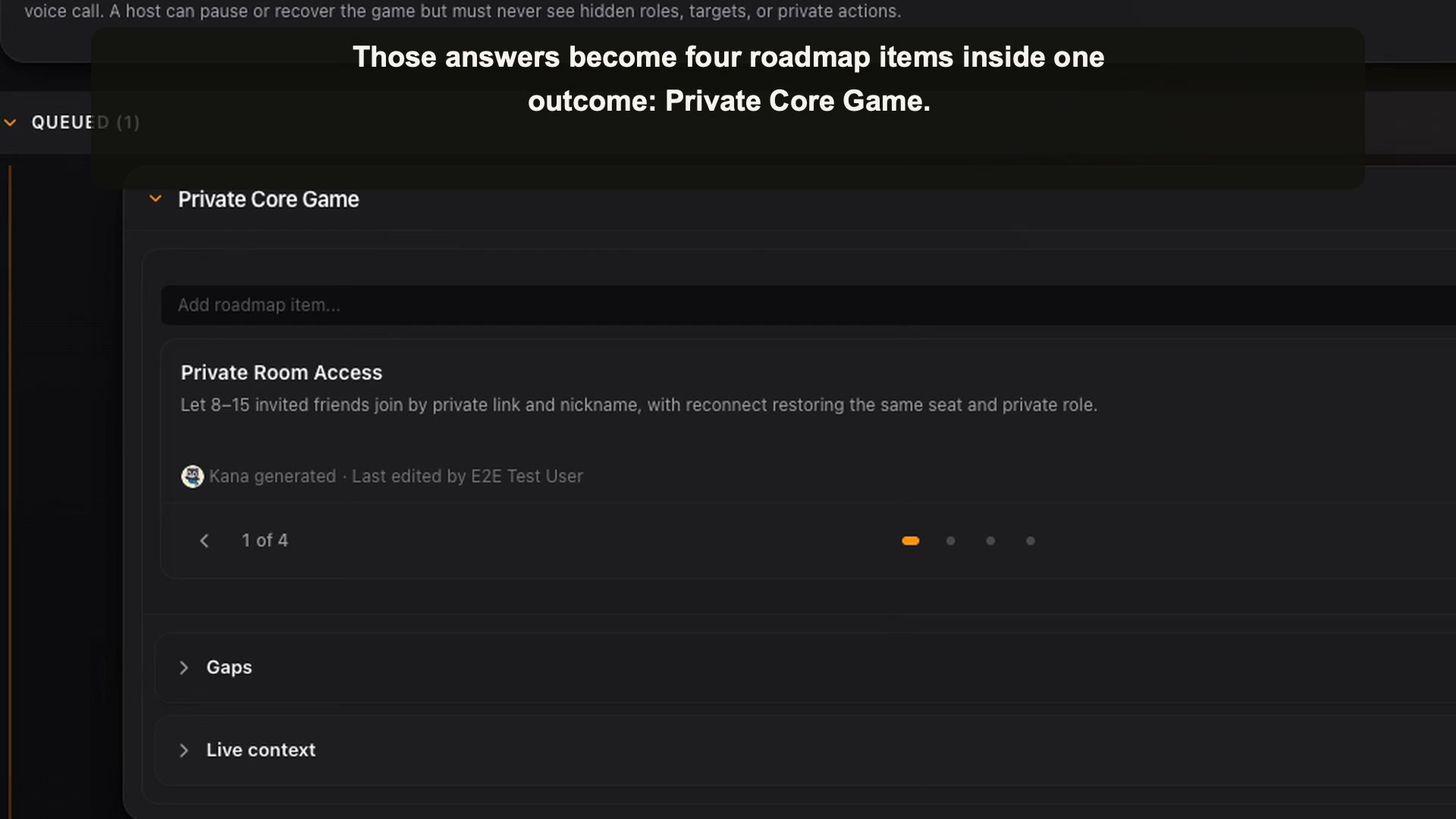
As Nadia decides, Kana shapes the work into a roadmap. In this walkthrough, the first playable game is covered by four focused items:
- Join a Private Room
- Receive a Hidden Role
- Play Guided Rounds
- Host Controls, No Spoilers
Those names give the team a quick picture of what the game must let people do. They also stay editable. Nadia can add an item herself, change its title or description, and keep refining the roadmap as she learns more. Kana can propose an item too. The workspace keeps the author so the team can see whether a change came from Nadia or Kana.
That small detail matters during product discovery. A roadmap should stay useful when a human changes the wording, expands the scope, or adds a newly discovered need. It should not become a fragile transcript that only an agent can maintain.
When is an outcome actually ready for Planning?
Roadmap items are easier to discuss when they also have a shared product result. Kana groups related items into outcomes. For Nadia, the room entry, hidden roles, guided rounds, and host controls belong together because they create a first game that friends can actually play.
The workflow keeps the state of each item visible. New items can begin as Proposed. Nadia and her team review them and move the included items to Accepted when the wording and scope are ready. The outcome becomes ready for the Planning session once its included roadmap items are accepted and its important gaps have been cleared.
This gives the handoff a concrete meaning. Planning does not start from a loose pile of prompts. It starts from an outcome whose intended experience, scope, and open questions have been reviewed.
Catch the “wait, what happens if…” moments early
The pleasant path through a Mafia game is simple: players join, get roles, chat, vote, and see the result. Real games become confusing at the edges.
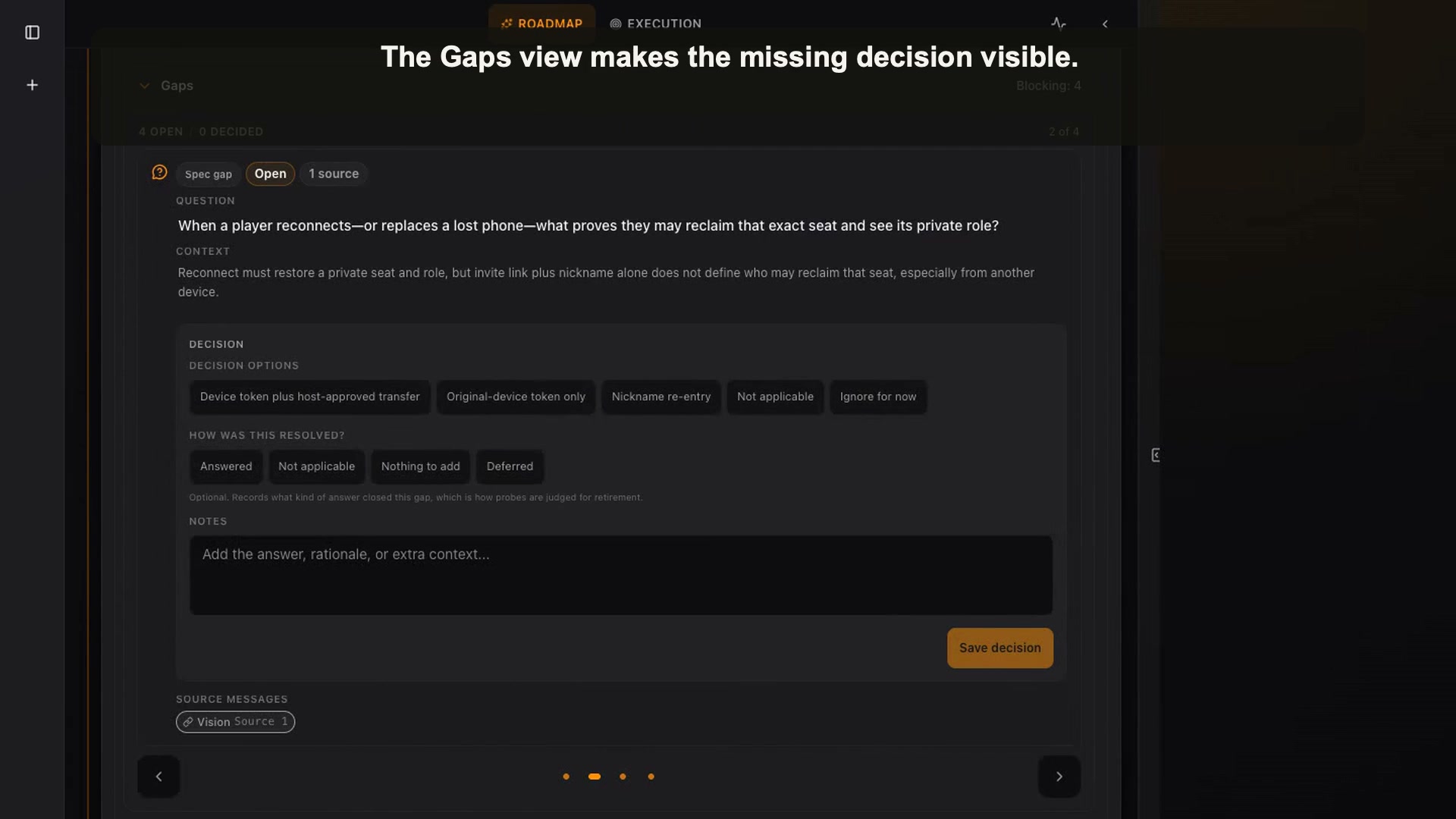
Kana uses the Gaps area to surface consequential questions before they turn into late surprises. Nadia works through examples that are easy to recognize in a live game:
- A tied vote causes no elimination and moves the game to night.
- A player who misses a night action is skipped when the timer closes.
- An eliminated player can keep watching the public conversation without seeing hidden roles or private actions.
- The host can guide the round without learning information that should stay secret.
These are product rules, not implementation details. They tell a later Planning session what the game must protect. They also make it easier for Nadia to notice a missing rule while the decision is still cheap to change.
Let the first game move forward without freezing the next ideas
Product discovery does not have to freeze while a team prepares the first outcome. Once Nadia has accepted the roadmap items for the first playable game and cleared the relevant gaps, that outcome can move to the Planning session.
At the same time, Nadia can keep adding future roadmap items, group them into new outcomes, and review them in Kana’s Vision session. A later outcome might cover moderation, invitation improvements, or a richer spectator experience. The first outcome can be planned while that future work is still being shaped.
This preserves momentum without mixing unfinished ideas into an outcome that is ready for a deeper plan.
Bring in the context your team already has — only when you allow it
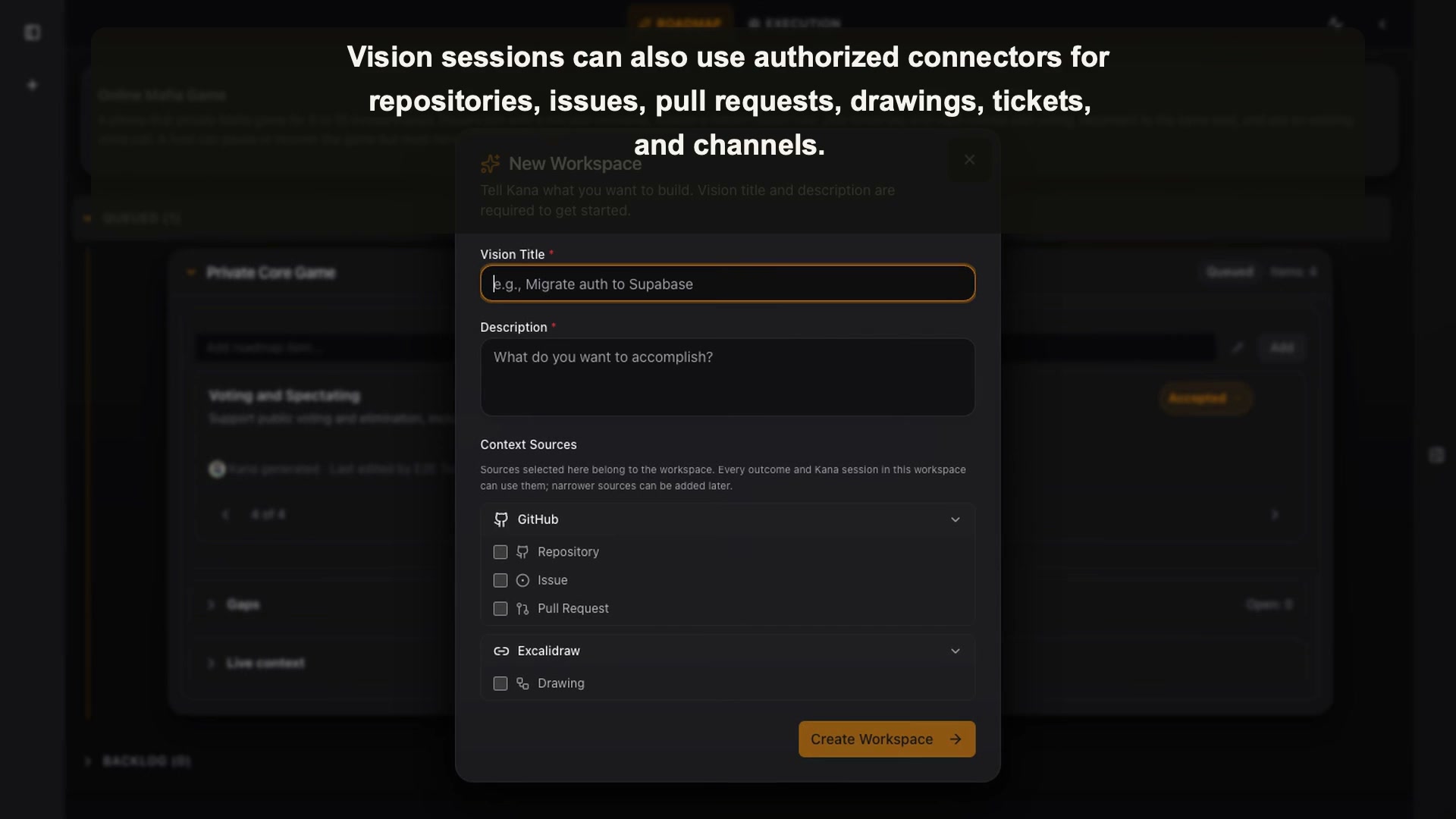
Some product decisions already have useful context elsewhere: a repository, an issue tracker, a support ticket, a design document, or a team discussion. Kana can use authorized connectors to bring that relevant context into the Vision session, which helps it ask better questions and avoids asking Nadia to repeat information the team already has.
Nadia does not need a connector for this first game example. The same capability becomes useful when the workspace needs to account for an existing service, a prior decision, or a constraint recorded outside Kana. Access stays intentional: the connector is there to add context when the team authorizes it, not to pull unrelated information into a product conversation.
The handoff: decisions in, a Planning-ready outcome out
Kana’s Vision session leaves Nadia with a product story she can inspect and edit: the player outcomes, the game rules that matter, the difficult cases, and the open work. When the first outcome is ready, the next episode will follow it into the Planning session, where the outcome is broken into tasks, user journeys, scenario-based acceptance criteria, and the blueprints that support each scenario.
Episode 1 stays at the product layer on purpose. Later Task execution episodes will show how Kana can run work through different agent runtimes, models, and machines while keeping the product decisions that Nadia made visible to the people reviewing the work.
Build your own Software Factory
Want to take your product idea through a Vision session? Join the Software Factory waitlist.
